|
HVVA
NEWSLETTER, March 2004 Vol. 6, No.3
(Click
on graphics/photos for larger view) THE
GERMANTOWN PARSONAGE
Saturday, March 27, Eleven members of HVVA (*)
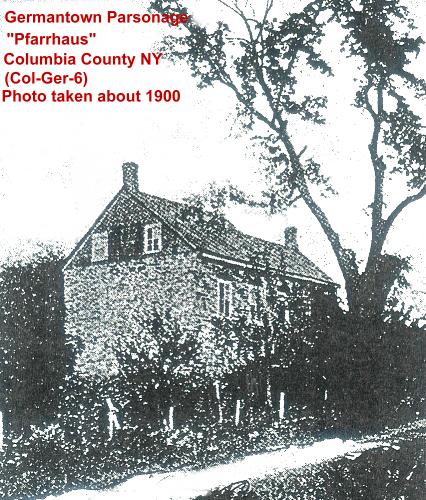
met at the Germantown Parsonage (Col-Ger-6), in southern Columbia
County. Once known as “The Pfarrhaus” it was located
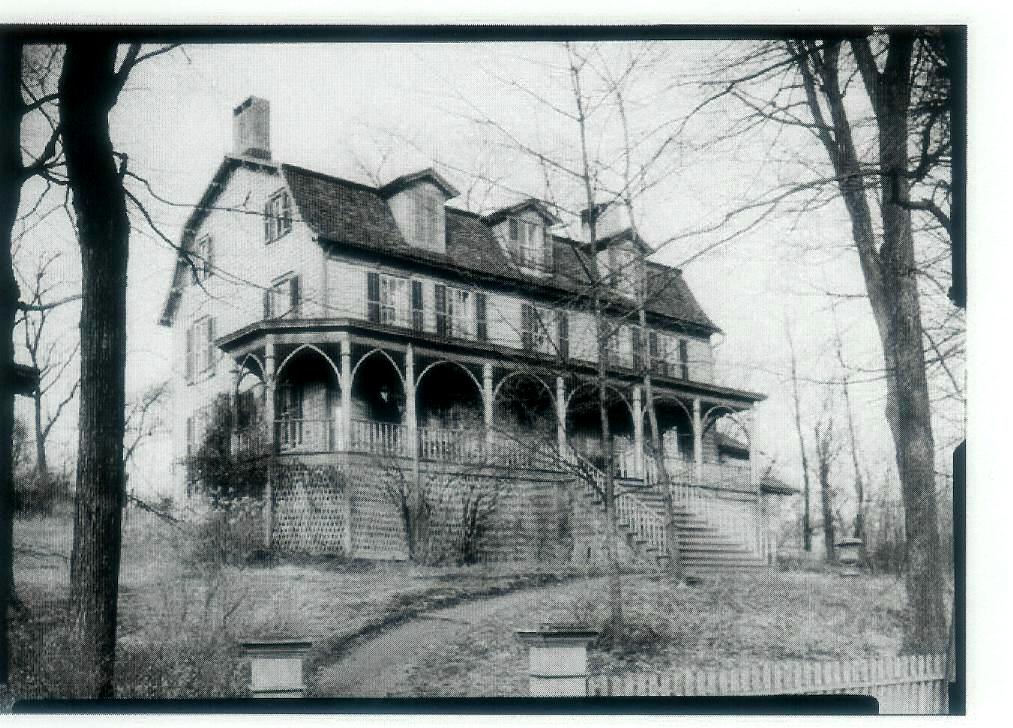
at a place then known as “Queensbury Village.” The parsonage is a stone house that was perhaps begun in 1746 to serve the first Reformed Church of the Palatine German families in the area. This first church is no longer standing. It was located about a half a mile away, closer to Sharp’s Landing on the River. The second church would be built about 3 miles inland on Church Hill near where the majority of the population would move and settle. These poor German refugees had fled the Palatine area of north western Germany because of wars, taxation and a severe winter that killed off the fruit trees and vines. Many thousands of homeless Palatines left their Rhineland for Holland and eventually England, where they lived in squalid tent cities. Officials were not sure how to alleviate the refugee situation. It was decided that the Catholics be sent back to Germany, some to Ireland, and Queen Ann would hire 3,000 Protestant Germans to go to the Hudson Valley and produce stores for her navy so that she could be free of her dependence on Scandinavian tar and wood. The Queen would provide transportation, tools, food and beer for the party, until the project was economically successful, and then the Germans could have land. Accordingly, 2,814 Palatines left England in ten ships. Four hundred-seventy people died at sea, thirty were born at sea. Many would die of illness soon after their arrival at Manhattan in the year 1710. The eleventh ship carrying supplies was suspiciously grounded and looted off Long Island. The naval stores project failed in its third year, in part they say, because this area of the Valley had no pitch pine and especially, it is written, because the Germans wanted to own land and farm, not to peel bark. The failure of the venture left the Palatine immigrants to establish themselves in this wilderness as best they could. For the first years they lived in temporary camps on the eastern and western shores of the Hudson River in Ulster and Columbia Counties. The 6,000 acres of Germantown were purchased by New York Governor Hunter to fulfill the promise of land for the German immigrants, but by the time of its first settlement in about 1724, many Palatine families had gone south into Pennsylvania or northwest into the Mohawk and Schoharie Valleys. Many who stayed became tenant farmers on the large manors of Livingston and Beekman. About 60 families acquired land in Germantown and began to establish farmsteads there. The late Germantown historian, Walter Miller, who preserved much of the history and local lore, describes the often colorful dominies who occupied the Parsonage and gives a sense of the complex ties that bound the community. The dominies included Rev. Johannes Casparus Rubel, who came from Philadelphia in 1755 and left Germantown in 1759 for Brooklyn on Long Island. He is known as “Rebellious Rubel.” A violent Tory, he denounced the American cause from his pulpits on Long Island, was deposed from the ministry in 1784 and died in 1797 at the age of 78. The dominie, Rev. Gerhard Daniel Cock, was of German extraction but ordained in Amsterdam, Holland in 1762. Soon after his arrival he married Christina Ten Broek, daughter of a prominent early Hudson Valley family. Cock was said to have been buried beneath the pulpit of the First Reformed Church and the exact location was debated for generations. In 1880 when the Third Reformed Church was built and the Old Church on the Hill taken down, it was found that Dominie Cock had been buried under the pulpit of the second church along with Dominie Hoff, who had died in about 1850 but whose remains had been moved elsewhere soon after. Cock’s bones were not disturbed but covered over and their location “forgotten by all but a very few.” They were rediscovered in 1911 when the land was sold for a cemetery. This account was given by the Rev. Harris A. Freer who served Germantown from 1924 to 35. Of the last dominie who came to the Parsonage in 1802 Walt Miller wrote in 1967:
In 1824, Dr. Wessel Ten Broeck Van Orden bought the Parsonage. Walter
Miller writes of its next owner:
My guess is that Henry Person, born in 1802, was a freed slave of Cornelius Persen of Katsbaan, a village of scattered farms and a small stone church, north of Saugerties on the road from Kingston to Albany. Cornelius Persen’s Store, a fur trading station, was located where the road to the Mohawk and Schoharie Valleys took a left to the west. Katsbaan was founded by Palatines from the West Camp in the early 1720.’s. The historian Benjamin Myer Brink, in his 1902 book, Early History of Saugerties, 1660-1825, describes the small inland village of Katsbaan as it was before the Revolution.
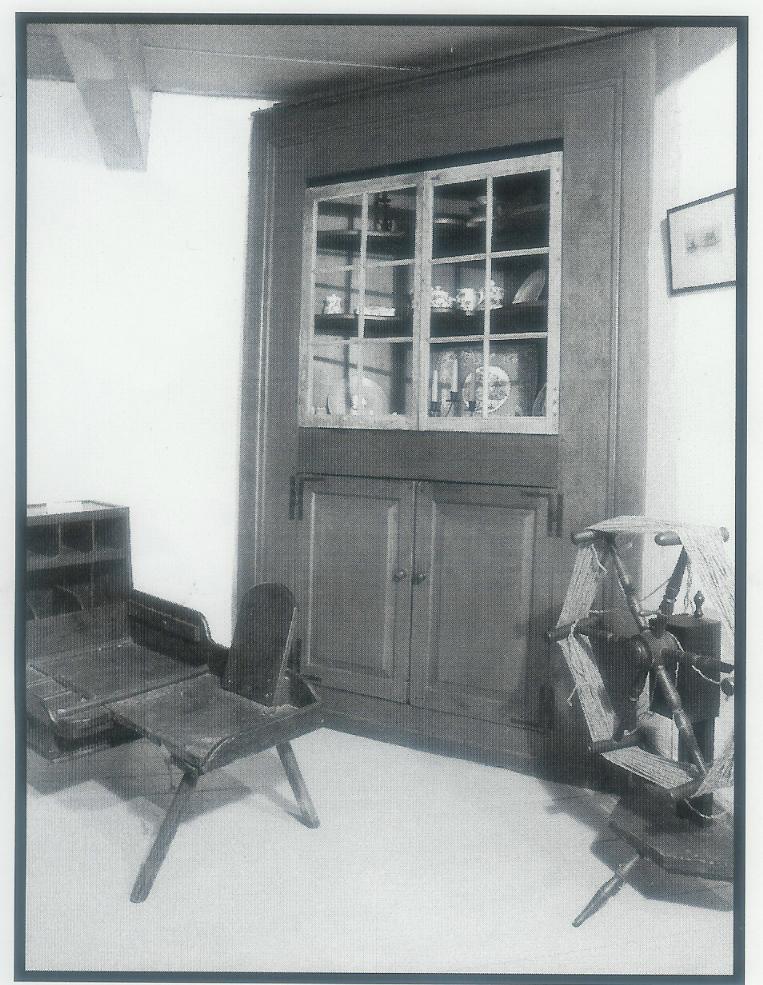
Eventually in the early 1940’s the Parsonage was acquired by the Ekert family. Recent immigrants from Germany, he was a chemist and they became interested in the local history and in acquiring local furniture and antiques. Their slow and careful restoration of the house was unfortunately not documented so that a number of questions remain about how the house developed and what kind of fireplaces it had. Its interpretation is based also on the oral history of its neighbors like Marguerite V. Riter, the present town historian, who knew the Ekerts. It is said that some of the paneling and perhaps some of the doors were parts of the first church. They had been stored, it is said in a barn, no longer standing, across the road. The heavy 6-panel false-panel doors in the basement of the house have a distinct Germanic feel with impressive double-pad hinges. The three exposed anchorbeams in the main room and cellar kitchen of the original side hall house have classic New World Dutch proportions yet there is no clear evidence of a hooded fireplace. The Germantown Parsonage is generally open to the public every Saturday. It has been examined and documented by John Stevens and others over the years and it still is not figured out. It still can yield a reward to the keen eye, like Jim Decker’s discovery on the tour of a pair of 6-light sash doors to the Lasher family corner cupboard. They were hanging forgotten in the loft. When he brought them down and fit them to the cupboard the size and hinge evidence matched perfectly. The one difference was their light gray paint, whereas the cupboard had been stripped and oiled by the Ekerts. Jim suggested the cupboard be painted again like the doors. It may have been neglect that saved the Lasher family cupboard doors, but it was plain good luck that saved the cupboard itself. It is part of the history of the Parsonage that when Mrs. Ekert died the will read that the house and land would go to Germantown but the contents of the house would go to Bard, a small private college 10 miles south in Dutchess County. A group of Bard faculty rented a dumpster and, without consulting people from Germantown decided what had potential value and what had no value, what would go in the dumpster and what would be sold. Many records and artifacts that could have been useful in understanding the history of the house went to the dump. It is said that these Bard professors liked the cupboard but it found it too large to get through the door, so that they had to leave it.
<-Click for larger view. Lasher Family Corner Cupboard in The Germantown Parsonage Germantown, Dutchess County, NY (The cobblers bench is kept in memory of Henry Person.)
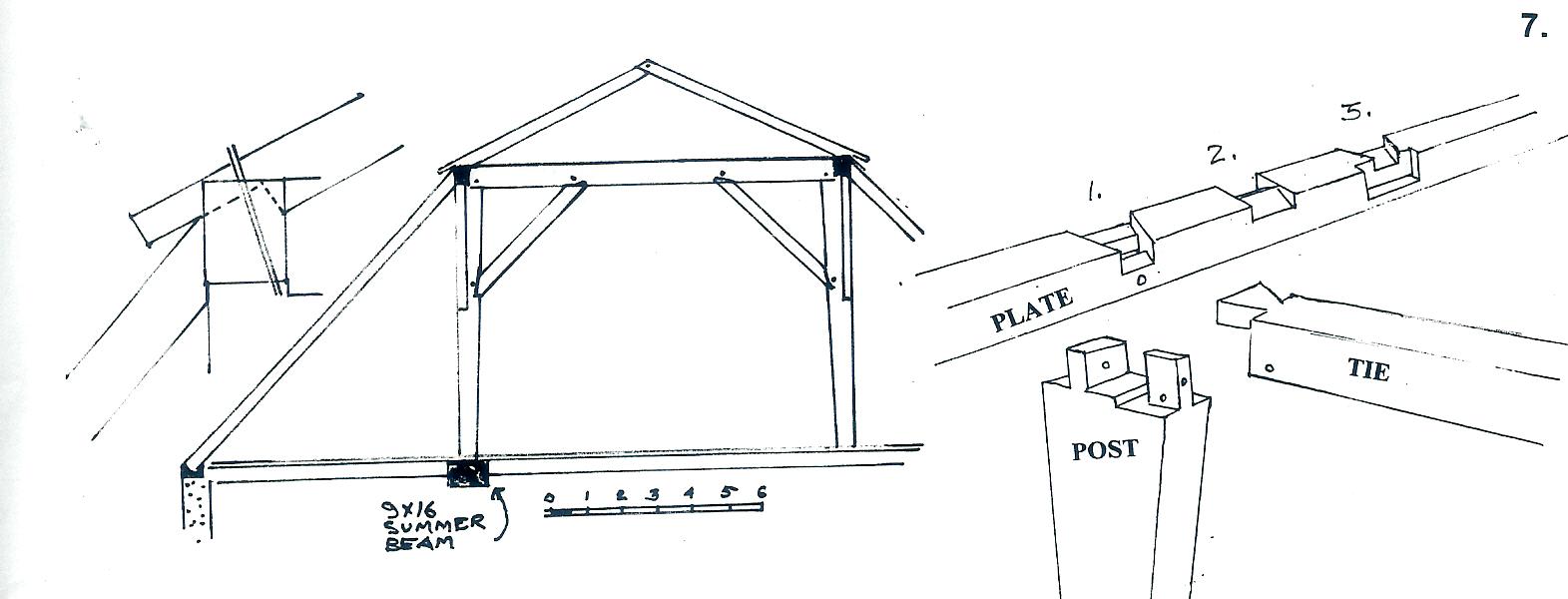
On September 9th, 1989, the Ekert collection was sold at the Pleasant Valley Auction House in southern Dutchess County. The dollar amount is still a matter of local speculation. Two or three Ekert items have found their way back home since the auction; one is a well-worn cobbler’s bench acquired in the memory of Henry Person, whose shoe making trade is listed in the 1850 census. (Alvin Sheffer and Marguerite V. Riter, helped with this report.) THE GENERAL PUTNAM HOUSE After the meeting, a small group of members went to the General Putnam house in Upper Red Hook (Dut-Rh-21) where Todd Scheff is doing some structural work leveling a ceiling. Some of us had briefly visited this 2-story brick house last month. We had seen that the frame was English, with summer beams and plastered ceilings, but we had put it off as an early Federal example not understanding the roof change with king posts and a ridge beam. On this second examination we discovered that the king posts were reused queen posts from a gambrel roof and that one of the owners, probably when the house was Victorianized, changed the roof from a gambrel to a gable, more in keeping with the fashion of the late 19th century.
(Click to see larger view.) Reconstruction of the Gambrel Roof and Details of its English Joinery General Putnam House, Upper Red hook, Dutchess County, NY. There is evidence of three types of joints in the surviving plate. These are 1) a vertical mortise and lap dovetail that joins the plate to the post and the tie beam; 2) a step-lap for the upper rafter; and 3) a shouldered gain with a lap dovetail to hold ties without posts. A clue to its ethnicity came when we recognized the reused posts as classic English flared posts. They are found on Long Island but these are the only examples of this New England type of timber framing that we know of in the Hudson Valley. They raise some interesting questions, since it is thought by a number of writers that the gambrel roof form was borrowed by fashionable people in the Hudson Valley from New England. In the structure of Hudson Valley gambrel roofs there is a clear distinction between English and Dutch design, queen posts versus collar ties.
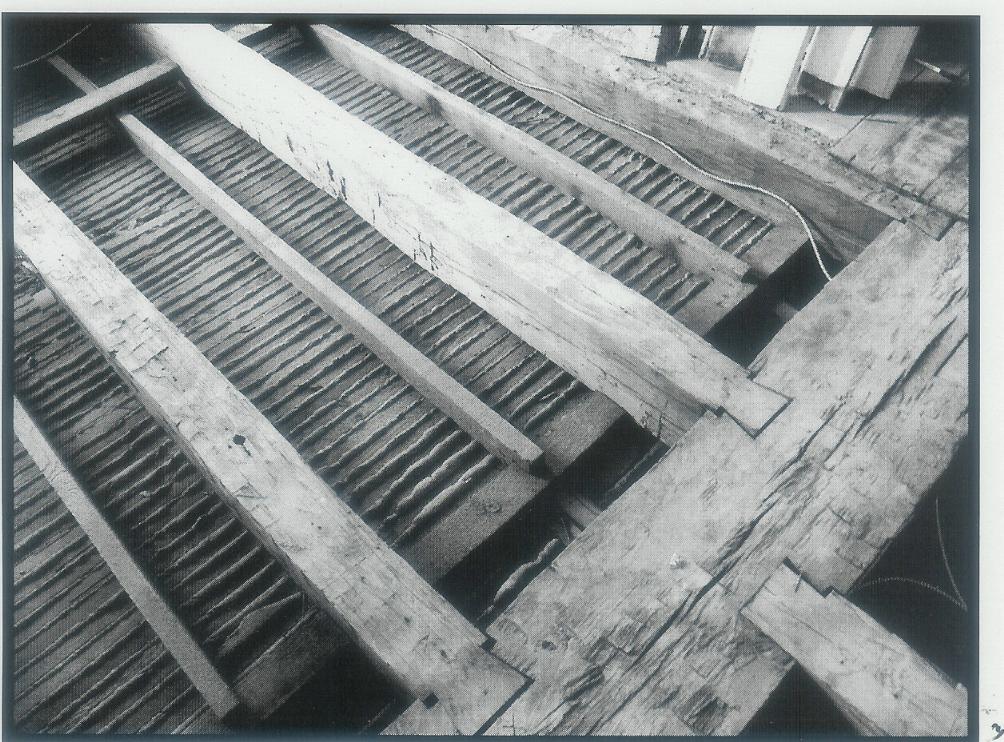
General Putnam House Upper Red Hook, Dutchess County, N.Y. The floor boards have been removed exposing the first period New England type construction of about 1760. A large summer beam holds the lighter floor joists, many of which are joined with lap dovetails. A lighter structure of sawn and nailed, circa 3-inch framing, supports the riven lath and the plastered ceiling which is squeezed between the lath to bond the two. The Hudson Valley Dutch did not plaster their ceilings, they exposed the anchorbeams and the undersides of the floor boards. Could it be that the Putnam House was an early imported example of the gambrel form that became very popular here in the 1760? The plaster lath is riven and the nails forged. It was probably Georgian rather than Federal and pre-dated General Putnam. We erroneously reported that the historic marker dates the house to 1740. The present owner, who has some background on the house, believes it may date to 1750. Jim Decker put us on to this 1933 HABS photo of the Gambrel roof house across the road. We will try to examine its loft. It no longer has its Victorian porch.
THE SOLITE BARN The report on the Solite barn, enclosed with the last HVVA Newsletter, was a rush job for the State that allowed no time to pass it by many people, especially John Stevens, who I hoped would add something, which he did, and I am including it in this issue along with some drawings to illustrate his points. John corrected two of my spelling errors and questioned one of my examples of nail saving evidence in the report. It was weak and confusing and so I will eliminate it from the next edition of the Solite Barn Report that will be a more refined and cooperative work. John made the suggestion that I change my simple threshing floor design, with wooden pins, for a more refined type of floor with rabbeted sills and a double rabbet on the center sill. This is a nice design but I had hesitated because I know of evidence for only one such barn floor in Ulster County, that being in some reused parts in New Paltz. I think of it as being a northern style of barn floor. On some of the most refined examples the ridge on the center sill is undercut which locks in the floor boards and holds them down without any nails. It is this kinds of detail that needs study. I got an E-mail from Greg Huber in Pennsylvania. He enjoyed the Solite Barn Report but questioned some of my conclusions and terminology. He wrote, “I believe I am correct in this. Your report says that the Gonzalez side-entrance barn in Dutchess County is an example of a major-minor rafter barn. The Gonzales barn does not have upper purlins, as this statement directly implies that there are lower purlins. There are certainly wall plates but they do not constitute lower purlins. The purlins certainly support the collar ties as is found in the m/m rafter barns of Ulster County. The similarity of the Gonzales barn to the m/m rafter barns is fundamentally found only in the support of the collar ties. And I believe it ends there.” Greg, You are correct the Gonzales barn does not have upper purlins but I cannot agree with you that the Gonzales and Teller barns do not have cultural roots with the Ulster County barns. Whatever we call these longitudinal timbers, in this Hudson Valley vernacular roof system, ‘purlins’ , or ‘upper-purlins,’ will not change their function. These purlins rest on the collar-ties, support the minor rafters and stiffen the roof from racking. You insist that major and minor rafters be of different sizes and so dismiss the Teller barn in Albany County, as “not in the same category.” Why not enlarge your category? Did you notice that on John Stevens’s centerfold measured drawing of the Solite barn, he labeled the major rafter a “principal rafter” and the minor as a “common rafter.” I think of these as being terms used to describe an English roof system that is distinct but a close cousin of our Dutch m/m barns. Going back a ways in time, I recall being in the loft of the 1766 Nieuwkirk barn in Ulster County. There was a handful of curious people, I believe that you and Jack Sobon were there. Jack pointed out the unusual rafter system. There had been a number of alterations made to the roof, including the removal of parts of some of the ties and ridge pole. This, with added purlin posts and a missing side aisle, made the barn a puzzle. It took quite a bit of persuasion for me to see what the original structure had been. Someone called it a “major-minor rafter system.” I recall that it was Jack who said it. (He says he didn’t.) Whomever, the m/m designation seems to fit and indicate its distinction from the English principal rafter system. Peter
Sinclair, Editor John R. Stevens on The Solite Dutch Barn
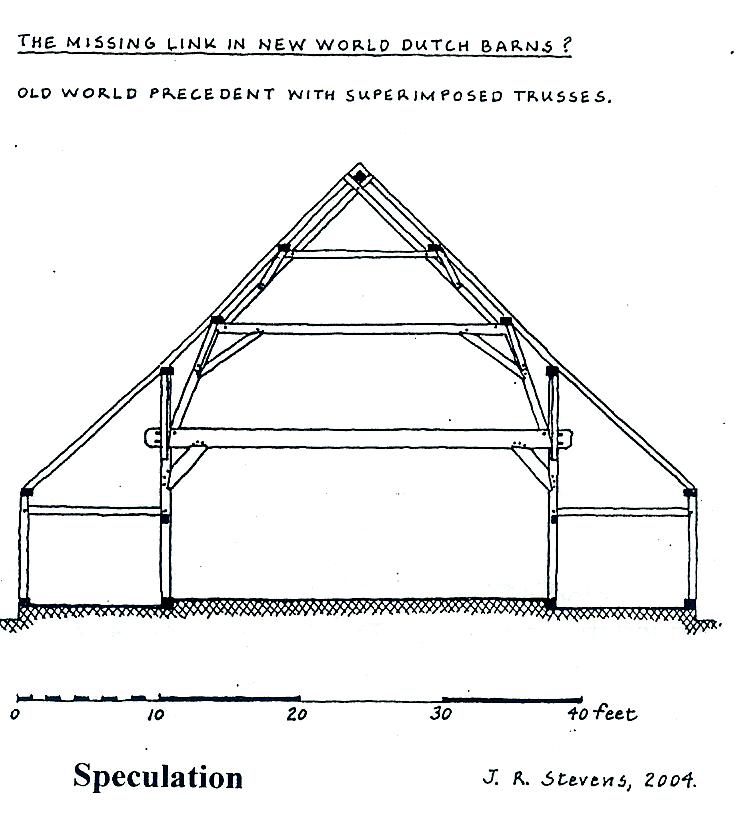
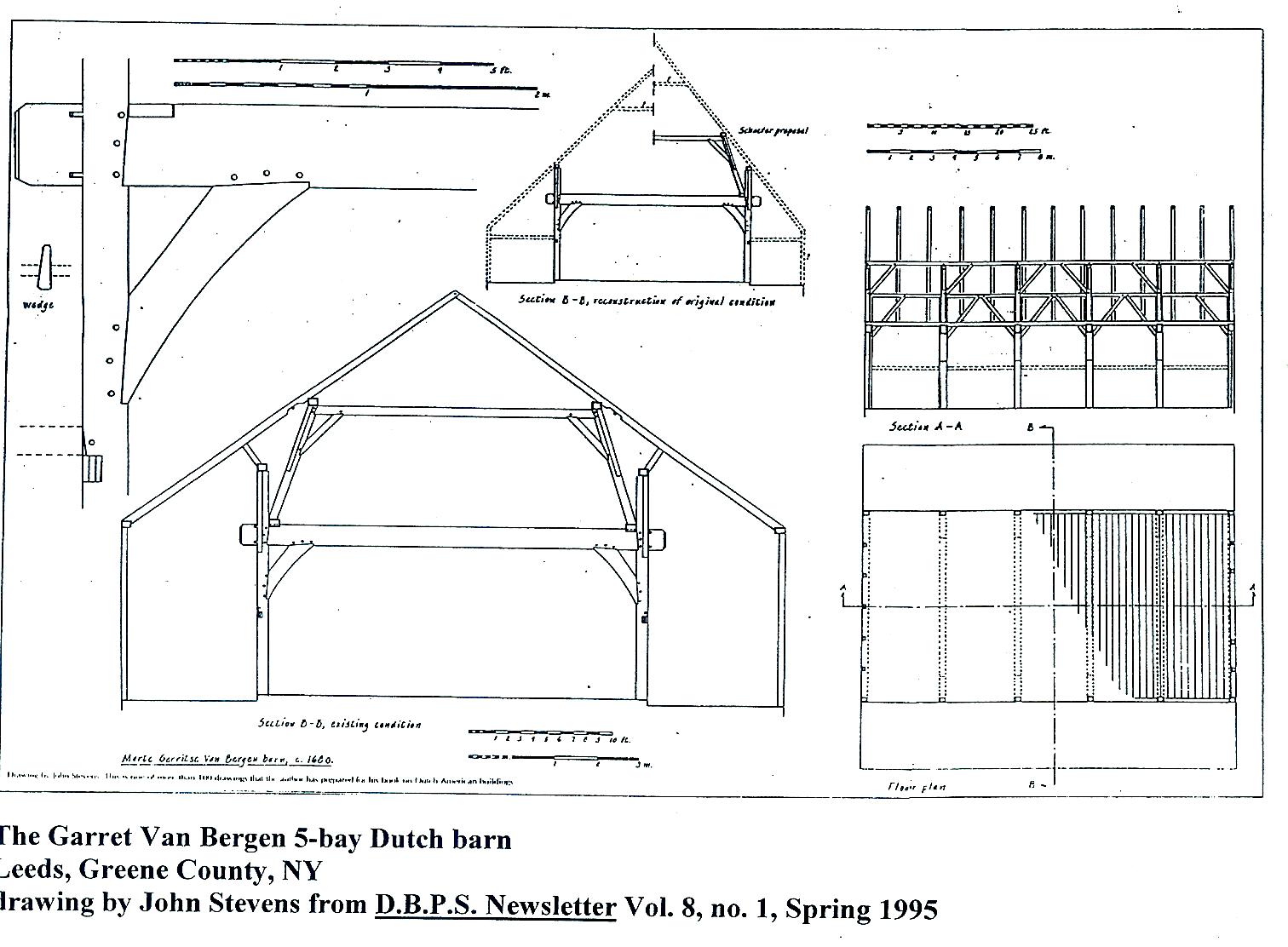
<-Click for larger view) The Nieuwkirk and 'Solite' barns represent, with their relatively complex roof construction, the earliest surviving specimens of Dutch-American barns. In the absence of other early specimens it is difficult to assess how representative they are of early building practices. The example from the Netherlands illustrated on page 9 of the report sent out with the last newsletter is from the Berends book... Houtconstructies.. .It is a strikingly close parallel to the American examples. However, many old-world Dutch barns, particularly those in the larger size range, have even more complex roof construction. Many examples are shown in the Brends book. Trusses are erected on top of the anchor beam, consisting of angled struts joined at the top with a tie and carrying rafter-supporting purlins. This same construction is also used in the roofs of houses The only American barn to survive into the recent past with this construction was the Garret Van Bergen barn, formerly at Leeds, Greene County, New York. It was reputed to have been built in the 1680's. Greg Huber, in his revision of John Fitchen's New World Dutch Barn (2002) revises the dating of this barn to 1729, the construction date of the still extant Garret Van Bergen house (see Huber, page 185) Huber's dating is very possibly correct. Dendrochronology could have determined the dating, but we are only now employing this technique to date Dutch-American buildings (in contrast, dendro dating is very advanced in the dating of early New England houses). The Van Bergen barn had a superimposed truss system carrying purlins, very similar to that used in Old World Dutch barns. The late Vince Schaeffer was of the opinion that the Van Bergen barn trusses were an original structural feature, and from my observation, the craftsmanship employed in them was not really distinguishable from the original H-bent framing. The barn had been rebuilt in the early 19th century when the side walls were replaced with higher walls and the rafters of a moderately pitched roof were supported on the truss purlins. The original purlins became redundant. Vince Schaeffer, in his belief that the trusses were an original feature, proposed a reconstruction of the barn in which the rafters were in contact with both purlins. This made a very steep roof (but not unlike the known roof pitches of houses of the time, like the Pieter Winne house of the 1720's) and unduly narrow (to my way of thinking) side aisles. The original rafters were re-used in the 19th century rebuild, and they showed redundant notches and broken pins and only a single bearing point where they had lain on, and been pinned to, the purlins. The writer is of the opinion that the trusses, because of their resemblance to Old World examples are a kind of 'red herring' and in spite of the craftsmanship in their being so similar to the original work, they were in fact part of the early 19th century rebuilding. Barns built in the 17th century, some of which are known from contracts to have been of considerable size might have had complex roof construction composed of superimposed trusses. This has to be speculative, however, since there are no known surviving Dutch-American barns from the 17th, or early 18th centuries.
(Click for larger view)
ANNUAL MEETING From the Editor: Eleven People attended the special meeting of HVVA Saturday, February 14, at the Marbletown Firehouse, Ulster County. Two new board members were voted in and a change was made in the make-up of the officers. The following was adopted: Alvin
Sheffer, President In addition, several committees were established to oversee the newsletter, select and schedule houses and barns to be documented and toured, to investigate costs and requirements for creating an HVVA website, and to continue working for the publication of John Stevens’s book on New World Dutch Architecture. Alvin says he wants to serve as president no more than one year. It was agreed the board would meet once a month for at least the next year. It was agreed that we have a lot to learn about the world of grant writing and that there is a lot of potential funding for HVVA It was decided that we should put together and publish a checklist for the documentation of vernacular architecture, one for houses and one for barns, in order to help standardize the process. It was felt that this might also help owners of historic properties in their interpretations and gain a public interest in historic documentation and preservation. A list of nine potential sites to be visited and documented was discussed and it was agreed that the Site Committee would determine priority and timing with structures in the greatest jeopardy given highest priority. The preliminary list of nine sites includes two in Columbia, four in Dutchess, one in Rensselaer, one in Ulster and one in Orange. Next board meeting: Saturday March 27th, 2004 at 10:00AM at the Person House in Kingston. Copyright © 2004. Hudson Valley Vernacular Architecture. All rights reserved. All items on the site are copyrighted. While we welcome you to use the information provided on this web site by copying it, or downloading it; this information is copyrighted and not to be reproduced for distribution, sale, or profit.
|